



Written by – Elijah J. Magnier:
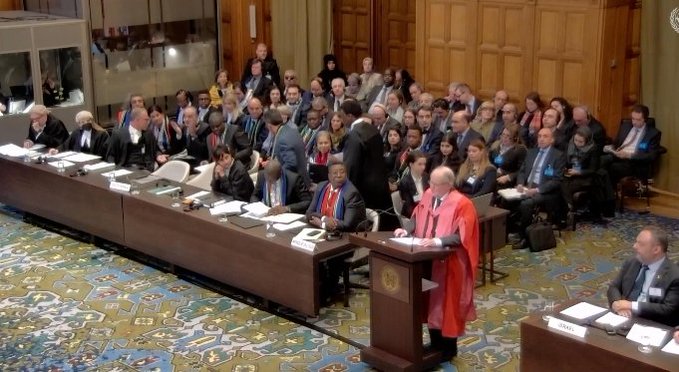
In an unprecedented move, South Africa has taken a bold stand at the International Court of Justice, challenging Israel’s actions in Gaza and the lack of US appetite to stop Israel’s killing. The session, initiated by South Africa’s submission, brought before the world’s highest judicial authority, part of the United Nations, an accusation of genocide committed by Israel against the Palestinian population of Gaza. This charge is based on the Genocide Convention, ratified by UN member states in 1948 after World War II. It aims to force Israel to cease its military operations immediately.
Israel has accused South Africa of acting as the ‘legal arm’ of Hamas militants, as lawyers presented Pretoria’s genocide case against Israel to the UN’s top Court. Israeli Foreign Ministry spokesman Lior Haiat described the South African case over Israel’s actions in Gaza as ‘one of the greatest displays of hypocrisy in history’. But it seems that Israeli cries are less likely to be heard than those of the thousands of Palestinian families and orphans who have been left without necessities in Gaza during the last 95 days of the devastating war.
South Africa’s case of justice is significant because it represents a role reversal for Israel. In the past, Israel supported the International Court of Justice to promote the world’s unity after the Holocaust. Now, Israel faces similar accusations, with its military being accused of committing genocide against the Palestinian population. Israel’s accusation of the judges or South African lawyers of anti-Semitism following its collective punishment and crimes presented at the International Court of Justice (ICJ) may not find a receptive audience and is likely to fall on deaf ears this time.
South Africa’s decision to take the matter to the International Court of Justice is a remarkable demonstration of courage and resolve, especially given that no other country in the Middle East or Asia has taken such a step. It underlines the growing concern that Israel, confident in its lack of accountability for its actions and the unlimited US support, has reached a dangerous level of impunity. This situation has escalated to the point where Israel appears indifferent to the need for self-restraint, posing a significant challenge to international peace and stability. The boldness of South Africa’s legal action is a pivotal moment, highlighting the urgency of addressing these grave concerns internationally and the need to restore international laws on all nations without exception.
South Africa, a prominent member of the BRICS organisation, which includes Brazil, Russia, India and China, along with other key nations such as Egypt, Ethiopia, Iran, Saudi Arabia and the United Arab Emirates, has taken a significant stance against Israel and its ally, the United States. The move comes as a challenge to Israel’s main ally, the US, and in response to over 200 statements by Israeli officials and UN institutions operating or responsible for Gaza and the actions by the Israeli military targeting innocent civilians. Moreover, the case included the UN Secretary-General Antonio Guteres’s statement that Gaza “has been transformed into a large graveyard for the Palestinians”. South Africa’s initiative to take the matter to the International Court of Justice was criticised by US Secretary of State Anthony Blinken, who described the case as ‘unnecessary and unhelpful’, claiming that it would distract from more pressing issues.
Nevertheless, South Africa’s decision has received considerable international support. The 22-member Arab League and the 65-nation Organisation of Islamic Cooperation back it. In addition, a diverse group of nations, including Belgium (vice Prime Minister), Colombia, Saudi Arabia, Pakistan, Brazil, Morocco, Nicaragua, Turkey, Jordan, Malaysia, Bolivia, Venezuela, the Maldives and Namibia, have also expressed their support for South Africa’s legal action. This broad support underlines the global concern over the situation in Gaza. It reflects a collective call for accountability and justice in the international arena.
South Africa’s immediate aim in taking its case against Israel to the International Court of Justice (ICJ) is to obtain a preliminary ruling for an immediate ceasefire, well ahead of a final decision that could take years. This approach is not unprecedented in international law. In a similar context, for example, The Gambia filed a case against Myanmar for the genocide of 740,000 Rohingya in 2017. The ICJ responded relatively quickly, taking only a month and a half to issue an initial ruling, with the final decision due in January 2020.
In another parallel, Ukraine filed a case against Russia in February 2022, and within a few weeks, the ICJ issued a preliminary ruling. In a show of solidarity and to avoid accusations of inaction or negligence, 32 countries eventually joined Ukraine in its case, demonstrating the commitment of the international community to address such serious issues.
Inspired by these precedents, South Africa hopes for a similarly swift first judgment from the ICJ. Other nations, reluctant to be seen as complicit or passive in Israel’s actions against the Palestinians, are expected to join the case. The primary objective is to stop military operations and prevent further civilian casualties immediately. This strategy underlines the urgency with which South Africa and its supporters view the situation and the need for immediate international legal intervention to end the civilian massacre.
The procedure for adjudicating this case at the International Court of Justice (ICJ) requires at least 8 of the 15 judges on the bench to agree on the preliminary and final judgments. Given the gravity of the statements made by senior UN officials, including the Secretary-General, the Israeli government’s members, and Knesset officials, the judges are expected to consider these submissions seriously. These statements address issues of collective punishment and crimes against humanity allegedly taking place in Gaza.
While the case may not lead to a unanimous finding of “genocide”, the depth and breadth of the evidence presented, particularly the perspectives and testimony of authoritative figures and institutions, presents a significant challenge to the judges. They are expected to find it very difficult to overlook or dismiss such substantial and influential testimony and reports. This factor adds a layer of complexity to the decision-making process. It is likely to influence the Court’s deliberations and the outcome of the case.
Given the compelling nature of the evidence and testimony presented in the South African case, it seems highly likely that the International Court of Justice (ICJ) will call for a cessation of hostilities shortly after completing its preliminary examination. Such a decision, calling for an immediate end to the conflict for humanitarian reasons, would be a significant setback for Israel. This is particularly true in the context of Israel’s historical attitude to international resolutions.
Israel has historically been perceived as flouting numerous international decisions in favour of the Palestinian cause, dating back to its establishment in 1948 – a point underlined in the South African submission. This pattern of non-compliance includes Israel’s response to a 2004 Security Council resolution on the controversial wall being built in Palestine. The resolution called for specific measures, including a halt to construction, the dismantling of parts of the wall already constructed and compensation for the hardship caused – demands that Israel has largely ignored.
In fact, in 2004, the International Court of Justice (ICJ) was requested by the UN General Assembly, through Resolution ES-10/14, to render an advisory opinion on the legality of the wall being constructed by Israel in the Occupied Palestinian Territory, including East Jerusalem. This request, made in the context of an emergency special session, sought to assess the wall’s compliance with international law, in particular the Fourth Geneva Convention and other relevant UN resolutions.
The ICJ’s advisory opinion on the wall addressed four key aspects: the legality of the construction of the wall under international law, procedural considerations relating to the General Assembly’s request, the ICJ’s jurisdiction and discretion in rendering the opinion, and the broader context requiring Israel and Palestine to comply with international humanitarian law, with a focus on the pursuit of a negotiated solution for a Palestinian state. The ICJ concluded that it had jurisdiction to issue the advisory opinion and that the General Assembly’s request was within its competence, noting that the political nature of an issue does not undermine its legal character.
The ICJ found that Israel’s construction of the wall was illegal under international law and that Israel was obliged to stop construction, dismantle existing sections and pay compensation for the damage caused. It also stressed that all states must not recognise the illegal situation created by the wall, must ensure Israel’s compliance with international humanitarian law and must avoid aiding and abetting its maintenance. The UN, particularly the General Assembly and the Security Council, was advised to consider further measures to end the illegal situation. Although non-binding, the opinion had significant implications for international law and the Israeli-Palestinian conflict and received mixed reactions internationally. Despite this, Israel continued to build the wall, deviating from the Green Line and affecting the rights and living conditions of Palestinian society. The European Union and its member states acknowledged the opinion but did not exert pressure on Israel to dismantle the wall or hold it accountable for violations.
Furthermore, the significance of this potential outcome is underscored by recalling the (Judge Richard) Goldstone Report. This report was an investigation into the actions of 2008 and 2009 following the 22-day war on Gaza. The Goldstone Report detailed numerous violations committed by Israel during its military operations, including war crimes and crimes against humanity. It highlighted the deliberate targeting of civilians and grave breaches of the Fourth Geneva Convention, as well as the use of disproportionate force.
The Goldstone Report, which investigated Israel’s conduct during the 2008-2009 Gaza conflict, found a series of serious violations no different from those committed by Israeli occupation forces since October 2002. It found that Israel’s direct targeting and arbitrary killing of Palestinian civilians constituted a violation of the right to life. The report also condemned actions such as the targeting of industrial sites and water facilities, the use of Palestinian civilians as human shields, the use of excessive force and the destruction of civilian property and infrastructure. These findings painted a bleak picture of the situation. They highlighted severe violations of international humanitarian law, which Israel appeared to ignore.
When the Goldstone Report was submitted to the Prosecutor of the International Criminal Court (ICC), it marked a significant moment. Still, the non-binding nature of such reports on Israel tempered expectations of its impact. Nevertheless, the news was crucial in shaping global and popular perceptions of the Israeli-Palestinian conflict. It contributed to a heightened awareness of alleged Israeli violations and the plight of the Palestinians. It also brought to the fore the notion of accountability – or lack thereof – in international law and governance.
The situation surrounding the Goldstone Report and similar investigations has led to growing scepticism about the effectiveness of international institutions and the equal application of international law. This scepticism is fuelled by the perception that powerful nations or allies are often shielded from the consequences of their actions, in sharp contrast to the treatment of less influential countries.
In the case of Gaza 2023, if the ICJ were to issue a ruling in line with South Africa’s request, and Israel continued its pattern of non-compliance, it could further cement Israel’s reputation as a pariah entity acting in defiance of international law and norms. This scenario would have significant legal implications and affect Israel’s international standing and relations with other nations and global bodies.
A decision by the ICJ in favour of South Africa’s case against Israel could have far-reaching implications, particularly for countries that supply arms to Israel, such as the United States, Germany, the Netherlands, France and Britain. Such a ruling would place these nations in a position where their continued support could be construed as violating United Nations mandates, potentially undermining the entire framework of international law. This situation could lead to a paradigm in which global relations are governed by the ‘law of the jungle’, characterised by the dominance of the strong over the weak, with little regard for legal or ethical consequences. Such a scenario would require re-evaluating global diplomatic and trade policies, particularly concerning conflict zones and the protection of human rights.
As a result, there is a growing widespread sense of disillusionment with international legal mechanisms and their ability to enforce compliance, mainly when dealing with allegations of genocide, war crimes or crimes against humanity. This disillusionment is also evident in public reaction, where there is growing awareness of the perceived injustices faced by Middle Easterners who suffered from the US-led Western wars and the ancient injustice the Palestinian people are suffering from. Criticism of countries that support or condone Israel’s actions and protect it, like the US and its Western allies, is unprecedentedly rising.
Israel’s reputation as a “democratic state” has come under intense scrutiny because of its actions, which are widely perceived as a criminal, rough entity eager for revenge and for extermination of the Palestinians. The openness with which these actions have been carried out and proclaimed has significantly further eroded Israel’s standing in the eyes of the world community. This shift in perception has been exacerbated by the unwavering support of its ally, the United States, which has also been criticised for its association with these policies and actions.
In this context, South Africa’s case against Israel is profoundly significant. By legally challenging Israel’s actions in an international forum, South Africa is not only seeking accountability but also striking at the heart of Israel’s international image and legitimacy. The case symbolises a broader global dissatisfaction with Israel’s policies, particularly on the Palestinian issue.
The potential impact of this trial goes beyond its immediate legal implications. It represents a significant moment in international relations, highlighting the growing willingness of nations to confront and challenge powerful states through legal and diplomatic channels. This shift reflects a changing dynamic in international politics, where public opinion and moral considerations are increasingly influential.
It also serves as a reminder of the importance of respecting international law and norms. It underlines the principle that no nation is above the law regardless of its power or alliances. The outcome of this case could have far-reaching implications not only for Israel and its allies but also for the international legal system and the enforcement of global justice.
Make a one-time donation
Make a monthly donation
Make a yearly donation
Choose an amount
Or enter a custom amount
Your contribution is appreciated.
Your contribution is appreciated.
Your contribution is appreciated.