By Elijah J. Magnier
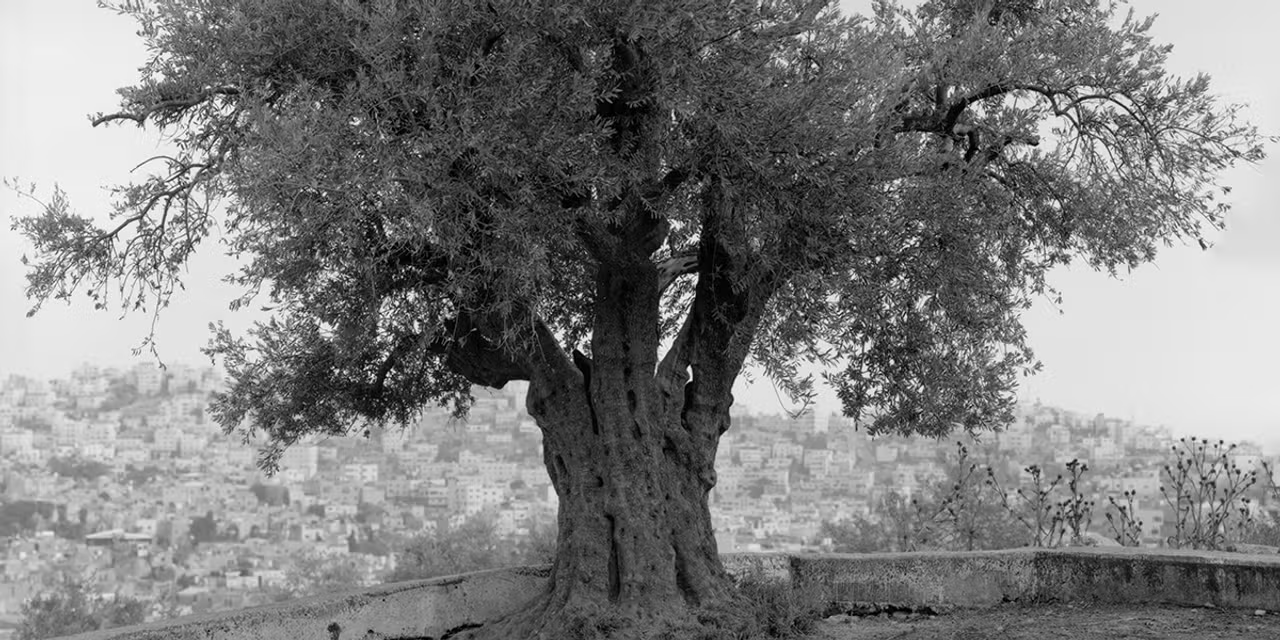
Avid observers of Middle Eastern geopolitics cannot ignore the relentless toll of Palestinian lives under Israeli fire in Gaza and the West Bank. Yet Israel has found another, quieter way of killing. Across the hills of the Levant, the olive tree stands as more than a crop: it is ancestry made visible, a living testament to endurance and belonging. From Palestine to southern Lebanon and northern Jordan, it bridges the sacred and the practical. To plant one is to declare faith in the permanence of land; to tend one is to join a lineage older than recorded history.
Since 1967 more than 800,000 olive trees have been uprooted or burned by Israeli authorities or settlers (Le Monde, 2024). During the 2025 harvest season alone, over 4,000 trees were vandalised and 16,800 damaged (OCHA, 2025). Each felled tree marks more than the loss of a livelihood—it is an assault on memory and identity.
The destruction is deliberate, not random. Psychologists and anthropologists describe it as symbolic violence (Bourdieu, 1991): a gesture of domination meant to sever the bond between people and place. Environmental psychology calls this place attachment—the emotional and cognitive link that gives communities stability and meaning (Altman and Low, 1992; Scannell and Gifford, 2010). To destroy what embodies that link is to attack identity itself.
Each olive tree is a biography in roots. Families in rural Palestine name their oldest trees and recount who planted them and through which wars they endured. Harvesting, pruning, and pressing oil are not mere agricultural tasks but rituals shaping the rhythm of life. When settlers destroy a grove, they shatter those cycles of meaning. Farmers describe the loss as bereavement; Amnesty International (2022) and Human Rights Watch (2019) record testimonies of villagers who liken it to losing a family member.
The Psychology of Uprooting
The destruction of olive trees is a campaign of despair. It seeks to induce learned helplessness—the belief that no care or resistance can prevent loss. Farmers replant only to see new saplings burned again, a cycle of grief that environmental philosopher Glenn Albrecht (2016) calls solastalgia: the distress of environmental loss in one’s own home landscape.
Make a one-time donation
Make a monthly donation
Make a yearly donation
Choose an amount
Or enter a custom amount
Your contribution is appreciated.
Your contribution is appreciated.
Your contribution is appreciated.
Subscribe to get access
Read more of this content when you subscribe today.
Make a one-time donation
Make a monthly donation
Make a yearly donation
Choose an amount
Or enter a custom amount
Your contribution is appreciated.
Your contribution is appreciated.
Your contribution is appreciated.

You must be logged in to post a comment.